Saturday, 11 May 2013

Security Force Members Killed (1977)


Text Reads:-

Security Force Members Killed
THE members of the security forces killed in action were named by Combined Operations Headquarters last night as:

Corporal District Assistant Teddy Tshuma (29), married with four children; District Security Assistants Amos Dube (25), married with one child; Benzenie Nyati (36), married with three children, Buyisa Tshuma (31), married with two children and Herod Mpofu (37), married with one child.

Combined Operations Headquarters also reported the murder by terrorists of Guard Ephraim Ngoshi (21), single, of Goromonzi district.
End

Source: Rhodesia Herald November 23, 1977 newspaper, made available to ORAFs from Rob Picton (Intaf)

Comments are always welcome, please mail them to Eddy Norris at orafs11@gmail.com


Ref. Rhodesia

Labels: , , , , , , ,

The Man from Hong Kong


Text Reads:-

The Man from Hong Kong

Herald Correspondent
HONG KONG.

THE number two man in the police force here has been tipped to head the police force in a "transitional" Rhodesia,

He is Deputy Commissioner Roy Henry (50) who is regarded as an expert in fighting terrorism.

A Government spokesman here confirmed that proposals for a senior Hong Kong policeman to be transferred to head the force in Rhodesia were being discussed.

Mr Henry joined the Malaysian police force aa a cadet officer in 1948 and served there throughout the emergency.

He later headed the special branch in the Malaysian State of Sarawak and was Jiji's police chief before its independence,

Mr Henry has refused to comment.


End

Source: Rhodesia Herald November 23, 1977 newspaper, made available to ORAFs from Rob Picton (Intaf)

Comments are always welcome, please mail them to Eddy Norris at orafs11@gmail.com


Ref. Rhodesia

Labels: , ,

Friday, 28 September 2012

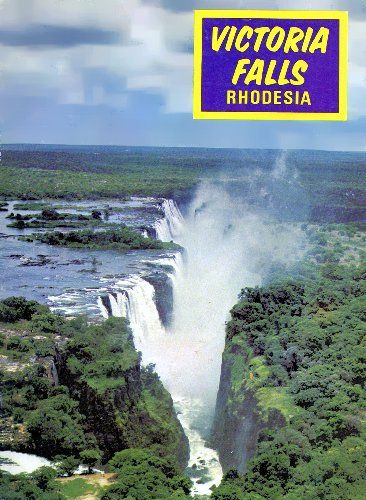
Victoria Falls

Ph1-Cover, Victoria Falls

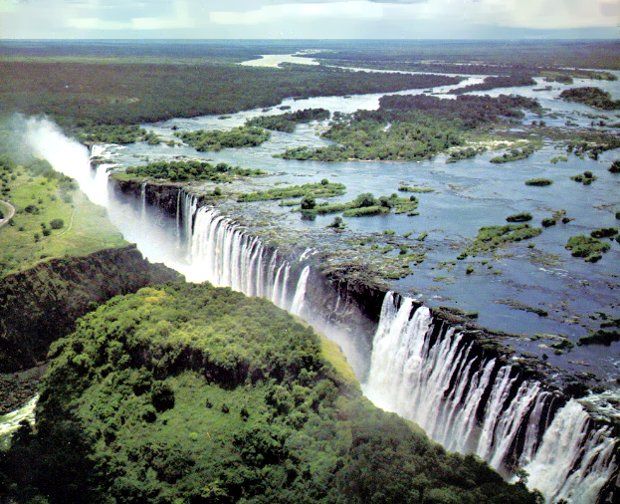
Victoria Fails is the tourist magnet of Africa. The reasons are not hard to find. The mile-wide curtain of water plunging more than 300 ft. into the gorge beneath is one of the treasured natural wonders of the world.
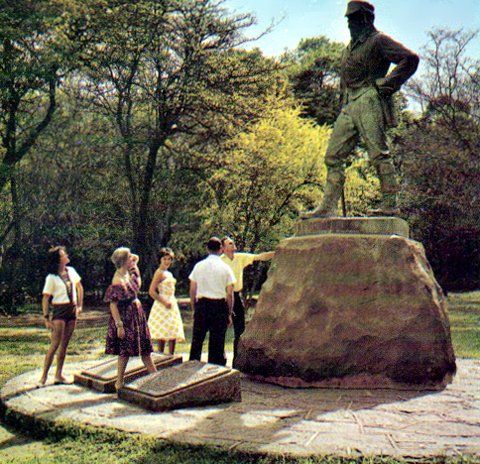
Ph2-1, Victoria Falls

The brave missionary-explorer, Dr. David Livingstone, having heard his Africans talk of mosi-oa-tunya (the Smoke that Thunders) or of chvngwc (the Place of the Rainbow), came down-river to the Falls on November 16, 1855, to see for himself and to proclaim their existence to men at large. A  statue of him stands on the bank overlooking the Devil's Cataract. Today the Falls are almost exactly as Livingstone first saw them, unspoilt in all their grandeur. Nothing has been allowed to mar the natural beauty of the surroundings: even the disfiguring precaution of guard-rails has not been permitted.

As Livingstone stood, lost in wonder, so do many thousands of visitors each year. And in the hotels and rest camps they can relax in modern comfort, making the Victoria Falls truly an international meeting place.
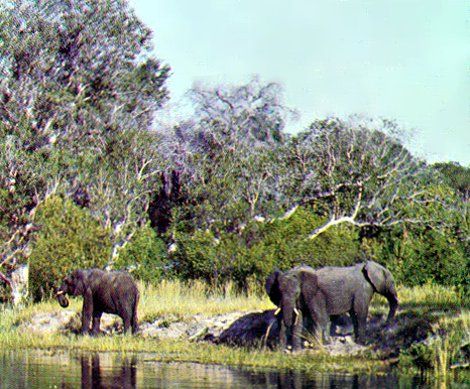
Ph2-3, Victoria Falls

During the dry summer months, June to November, the visitor can see elephant and other game within a few miles of the village, for the Falls is the focal point of a 230-square-mile National Park, which spreads some 35 miles along the Rhodesian bank of the Zambezi.
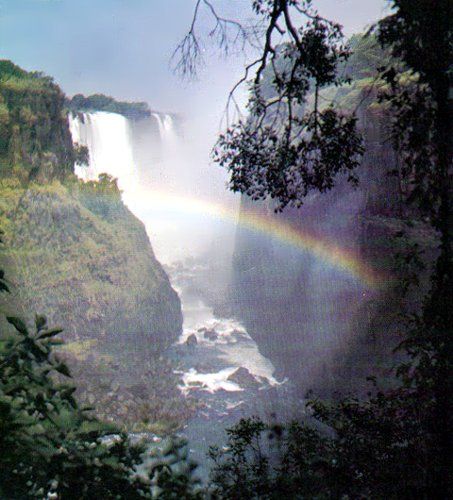
Ph2-2, Victoria Falls

A chain-assisted path (known as the Chain Walk), descending one-third of the way down the side of the gorge, enables the visitor to see the final plunge of the Devil's Cataract and, along the full length of the gorge, a vista of the rest of the Falls.

Archaeological evidence indicates that the Falls area has been inhabited for many thousands of years, but the present inhabitants—the Tonga people—probably moved from Kasai, in what is now the Congo Republic, no more than 500 years ago. Little of their tradition and culture goes back any further than the time of David Livingstone.
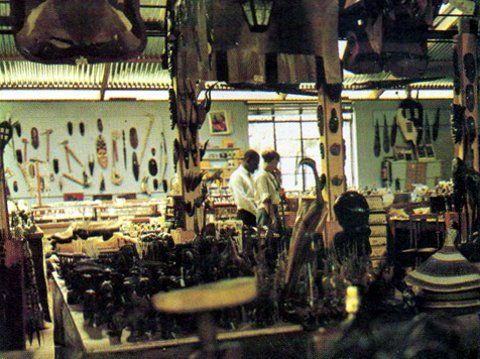
Ph2-4, Victoria FallsNevertheless, much tribal craft derives from the wealth of timber in the region, such as Rhodesian mahogany, ebony and teak, and a softwood from the Featherweight tree. A variety of carvings and many other curios may be obtained from well-stocked shops in the village.
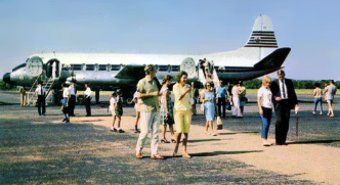

Ph3-1, Victoria FallsFrom Johannesburg, Bulawayo, Salisbury, Kariba and Wankie, more than 21 flights a week serve the new airport 15 miles south of the Falls. Visitors from the north come via Livingstone Airport, nine miles north of the Falls, in Zambia. All-inclusive Flame Lily holidays starting from most centres in Southern Africa are on sale all over the world.
Ph3-2, Victoria Falls

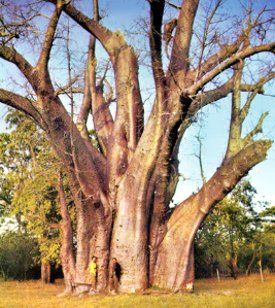
From Livingstone's statue there is a path and roadway up-river to the Big Tree, a huge baobab almost 67 ft. in circumference at its base but reduced in height by a storm in 1960.
Ph3-3, Victoria Falls

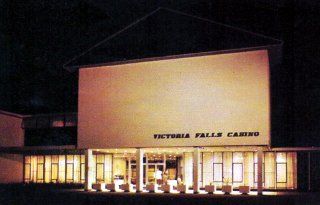
The modern, luxurious Casino Hotel was opened in 1966. It is air-conditioned throughout and has a large conference room, a bank, hairdressing salon, jewellery and other shops for the convenience of its patrons, besides a la carte restaurant serving breakfast 24 hours a day, for the convenience of patrons of the casino hall.
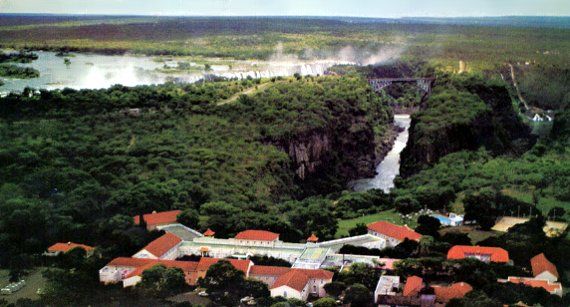
Ph3-4, Victoria Falls

The famous colonial-style Victoria Falls Hotel, with its 120 bedrooms, also has a bank, hairdressing salon and shops, as well as a conference room. Air Rhodesia and United Touring Company (offering cars for hire) have offices there. Many visitors come by rail, and there are all-inclusive Rainbow tours (by rail) from all centres in Rhodesia.
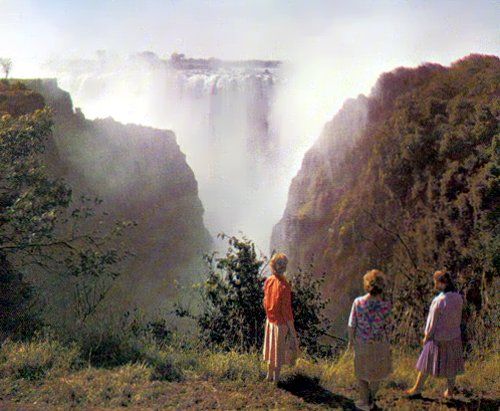
Ph4-1, Victoria Falls

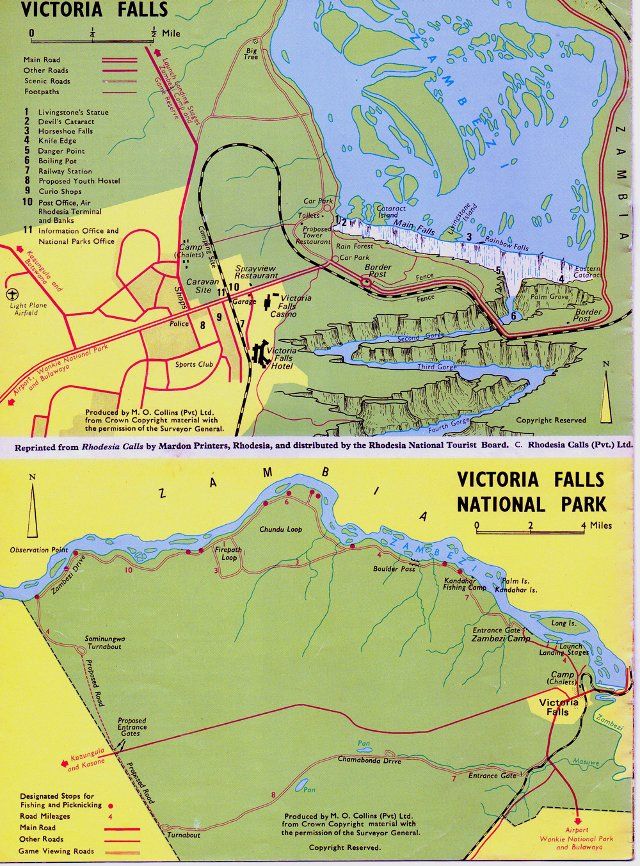
The 1860-yard crest of the Falls is divided into five separate waterfalls—the Devil's Cataract, Main Falls, Horseshoe Falls, Rainbow Falls and Eastern Cataract. The fastest- and deepest-running water goes over the Devil's Cataract, next to the Rhodesian bank. The mean height of the Falls is 304 ft. The second major curtain of water, the Rainbow Falls, is the highest (355 ft.).

When crossing from Rhodesia into Zambia the visitor must pass through full border formalities on both sides.

From the road can be seen the gap where the river continues its way below the Falls, Between Danger Point on the Rhodesian side and the less accessible opposing promontory called the Knife Edge, swirl the turbulent waters of the Boiling Pot.
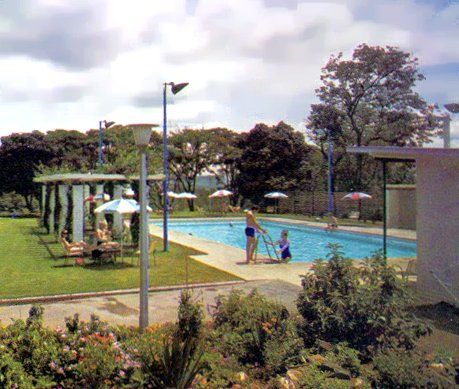
Ph4-2, Victoria Falls

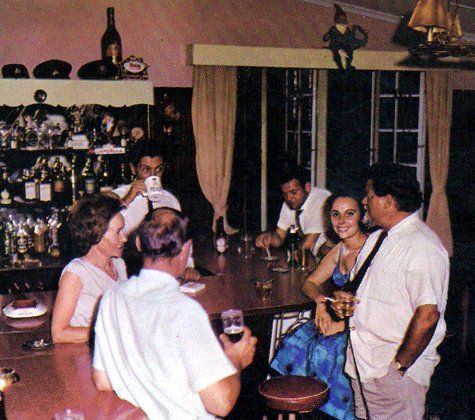
Both hotels have swimming-pools. The one at the Casino has underwater lighting and is set amongst lawns Mopane trees. The Falls Hotel has tennis courts and a refreshment kiosk alongside a pool which commands fine views of the Second and Third gorges.
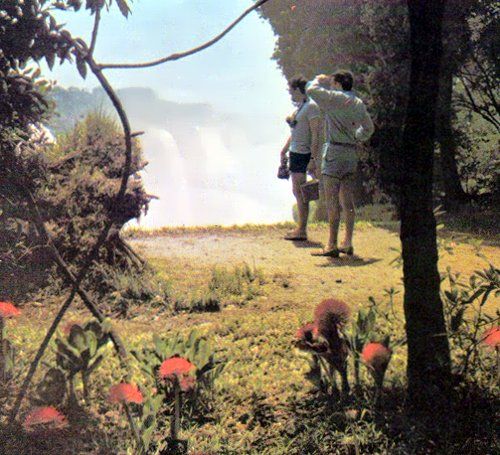
Ph4-3, Victoria Falls

Opposite the western half of the Falls and for almost three-quarters of their length, a footpath passes through the Rain Forest, a dense tree-jungle nurtured by the incessant spray of the Falls. The floor of the Rain Forest is covered in November by masses of red Haemanthus filiflorus and the path gives access to a series of remarkable head-on views of the torrent from relatively few yards' distance.
Ph4-4, Victoria Falls

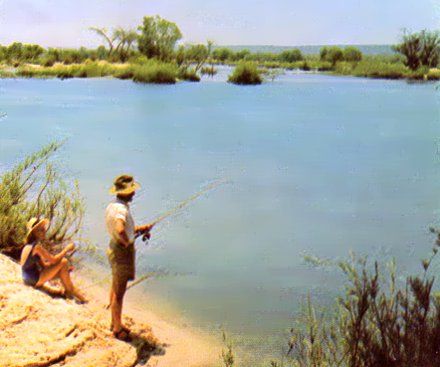
Tiger fish and bream give anglers good sport ail the year round in the Zambezi, and a licence is not required. Designated fishing-spots and a fenced fishing-camp opposite Kandahar Island have been provided along the Zambezi Drive.

Ph5-1, Victoria Falls

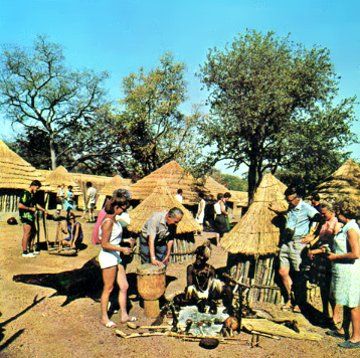
Near the hotels a replica of a 19th Century Matabele village has been created. It is open to visitors throughout the week and craftsmen can be seen making the various implement and curios which are on sale.
Ph5-3, Victoria Falls

Near the hotels a replica of a 19th Century Matabele village has been created. It is open to visitors throughout the week and craftsmen can be seen making the various implement and curios which are on sale.
Ph5-2, Victoria Falls

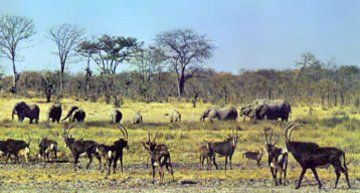
The National Park has fine herds of the national animal— the princely Sable antelope—which is relatively rare in other parts of Africa. Other animals easily seen include buffalo, kudu, water-buck, bush-buck, impala and warthog.

Ph6-1, Victoria Falls

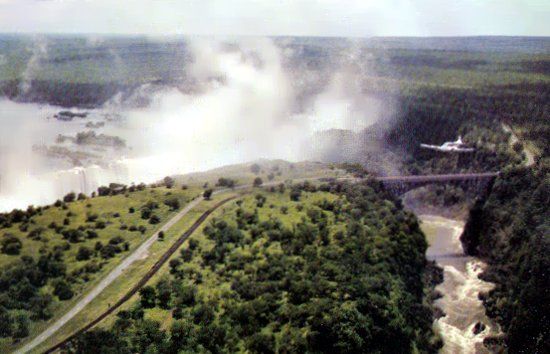
To be appreciated fully, the Falls should also be seen from the air. Several air-excursions by Rhodesia United Air Carriers are available, and reservations can be made at either of the hotels. Described by most passengers as the highlight of their visit is the Zambezi Sky Safari. This is a flight of more than 200 miles over country teeming with game. The route is westerly to Botswana, then returning along the course of the Zambezi, and culminating in several circuits over the Falls. The flight affords unique opportunities for the photographing of wild animals, very often in herds of hundreds. The 219-yard road/rail bridge was built, at the direction of Cecil Rhodes, at a point where the spray would fall upon it. It is 310 ft. above the gorge at high water.
Ph6-2, Victoria Falls

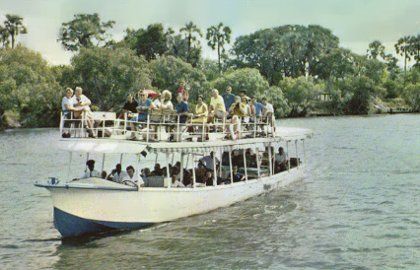
A launch trip on one of Africa's loveliest rivers for a picnic tea on Kandahar Island is a rewarding
experience. Hippo are invariably seen, and sometimes crocodile.

In the dry months of July to November, elephants and other game may be spotted on land or in the river.

The bird life is of never-ending interest. The launch operators' offices in the village arrange transport
to the landing-stages two miles up-river of the Falls.
Ph6-3, Victoria Falls

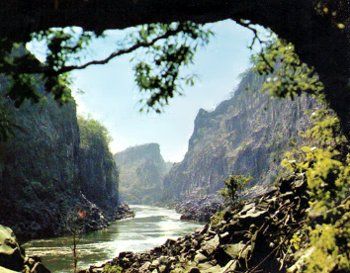
For many people the gorges through which the Zambezi flows for many miles downstream have a
fascination almost as great as that of the Falls themselves- There are eight such gorges, and good viewpoints exist for nearly all of them. Numerous walks may be taken to see the gorges. From the hotels, pathways lead to the Second and Third gorges and provide fine vantage-points. On the road from Bulawayo, and two miles before reaching the Falls village, a drive to the crest of a hill offers a panoramic view both of the gorges and the Falls,
Ph7-1, Victoria Falls

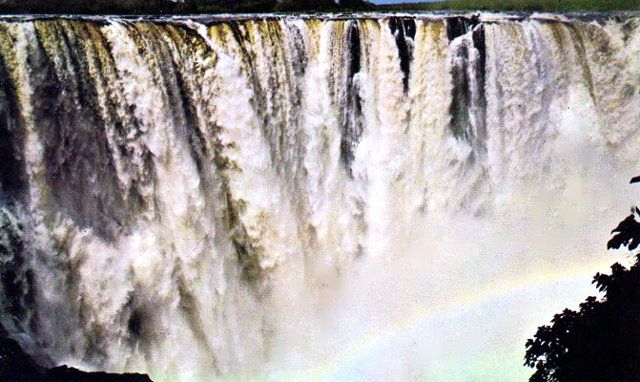
The most impressive stretch of the Falls, and certainly the most photographed, is the majestic 800-yard-wide Main Falls, which lies between Cataract Island and Livingstone Island. The usual flow of water over the whole of the Falls in April is 75 million gallons per minute and, although diminishing in October, the flow at that time is still considerable. Conditions are thus ideal for sight-seeing from the Rain Forest, for visitors do not get drenched by the spray. There are also clearer views for photography when the flow is below maximum.
Pg7-4, Victoria Falls

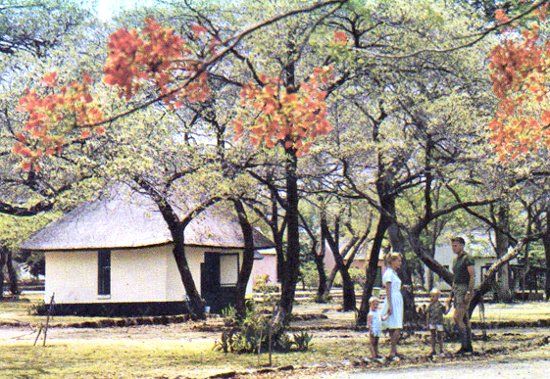
There are two well-equipped rest camps. Four miles upstream is the Zambezi Camp, which consists of 20 self-contained luxury lodges ranged along the river bank, in secluded surroundings. In the village more than 30 chalets are set amongst pleasant gardens and colourful shady trees. There is a caravan park at the chalets, and a site for camping. Only a few minutes walk away are the licensed Sprayview Restaurant and a small shopping centre. The National Parks' Reception Office contains an Information Bureau.
Ph7-3, Victoria Falls

Those requiring further information should write to:
The Warden, Victoria Falls National Park
P.O. Victoria Falls, Rhodesia.

Ph8-1, Victoria Falls

Reprinted from Rhodesia Calls by Mardon Printers, Rhodesia and distributed by the National Tourist Board. C. Rhodesia Calls (Pvt) Ltd.

End

Extracted and recompiled, by Eddy Norris, from material made available by Darryl Burlin, and for use on Our Rhodesian Heritage that ORAFs administers.
Thanks to Darryl.

Comments are welcome, please enter them below or mail them to ORAFs and they will be uploaded to this article

To view the Blog Home Page - Please Click Here.
 
(Please visit our previous posts and archives)

Labels: , ,

Wednesday, 7 December 2011

Rhodesia's Wankie National Park

Cover, Rhodesia's Wankie National Park

Page 2 - 1, Animals of Rhodesia's Wankie National Park

Pg 2 -2, Map of

THE Wankie National Park, occupying an area of over 5,000 square miles in the Western region of Rhodesia, has been described by the world's most-viewed wild-life television programme as "Tusker Territory". This title is certainly apt, for in the northern part of the park the many water-holes attract a large proportion of the reserve's 7,000 elephant as well as many other species of game. Visitors' cars are often held up by herds of elephant up to 250 strong and by buffalo herds of 400 or more. But there are not only elephant and buffalo: Wankie is well noted, too, for its variety of animals. More than 50 species inhabit the reserve.

Accessibility has increased the reserve's popularity enormously in recent years, and close proximity to the world-famous Victoria Falls has spurred further development of access routes, game-viewing roads and touring and accommodation facilities. At the same time, however, careful planning has ensured that camps are of a limited size and many miles apart, thereby guaranteeing uncrowded game viewing. Each visitor can thus, savour to the full the individual experience of seeing an elephant cow washing her calf, a bambi-like steenbok on the roadside, a pride of lion on a kill in short, untamed Africa.

WHEN TO GO THERE
Main Camp is open throughout the year. Sinamatella and Robins, in the north, are open from June 1 to November 30, subject to the condition of the roads after the rainy season (Nov.—March).

Page 3-1, A general view of Main Camp
A general view of Main Camp

HOW TO GET THERE
The Park lies between the main road/line-of-rail from Bulawayo to Victoria Falls, and the Rhodesia Botswana border.

Pg 3-1, Arriving on a C.A.A. aircraft at Main Camp
Arriving on a C.A.A. aircraft at Main Camp

By air from the new Rhodesian airport at Victoria Falls and from Salisbury via Kariba there are eight scheduled DC3 flights a week to Main Camp, and this number is usually increased between June and October. Wankie is prominently featured in the national airline's "Flame Lily" all-inclusive holiday tours marketed throughout the world.

Pg 3 -2, an attractive lodge at Main Campan attractive lodge at Main Camp
An attractive lodge at Main Camp

Pg 3-3, The restaurant at Main Camp.
The restaurant at Main Camp

By rail, trains from Bulawayo and Victoria Falls daily arrive at and depart from Dett Station, and transport is available for the visitor to cover the 14 miles to Main Camp. The Railways run "Game trail" package tours to Wankie and "Rainbow" package tours to the reserve and the Falls from all centres in Rhodesia.

By road there are separate access roads to the three camps from the new modern highway between Bulawayo and Victoria Falls. Main Camp is 14 miles from a turnoff,' 162 miles from Bulawayo or 120 miles from the Falls. Sinamatella Camp is 30 miles from Wankie township, which is 70 miles south of the Falls and 212 miles north of Bulawayo. Robins Camp is 44 miles from a turn-off at Matetsi, only 32 miles from the Falls.

ACCOMMODATION AND FACILITIES
Accommodation for 200 persons is provided in three rest-camps, and lodges for another 50 people are under construction. Accommodation varies from single roomed chalets to double-bedroomed lodges with dining-room, kitchen, bathroom and toilet. All chalets and lodges have basic furniture with drinking water, hot baths and water-borne sanitation within or close by. Bedding, refrigerators, cooking utensils and fuel are available if required. Each camp has a petrol-filling station; a store selling foodstuffs, liquor, toilet requisites and photographic film; a licensed restaurant with reasonably priced table d'hote meals which often include a Rhodesian dish such as eland steak or jugged impala; a caravan site and camping site, both of which have the use of the camp facilities and are floodlit at Main Camp.

Main Camp is in the south-eastern corner of the Park and has been established for about 30 years. At present it has 24 chalets and one lodge, with total accommodation for 54 people, but a further 25 two-bed lodges (each with a bathroom and toilet but without a kitchen) are now being built. The air strip is alongside the camp.

Pg 4-1, A general view of Sinamatella, perched 180 ft. above the plain below
A general view of Sinamatella, perched 180 ft. above the plain below

Sinamatella Camp was opened in 1966 and lies near the Park's northern border. It consists of 20two-bedroomed luxury lodges which extend along a ridge commanding a fine view for many miles to the south.

Pg 4-2, one of the well-constructed lodges at Sinamatella
One of the well-constructed lodges at Sinamatella

Pg 4-3, The restaurant at Sinamatella.
The restaurant at Sinamatella.

Pg 4-4, A typical interior of a thatched chalet at Main Camp and Robins
A typical interior of a thatched chalet at Main Camp and Robins

Pg 5-1, The restaurant at Robins
The restaurant at Robins

Robins Camp was named after a rancher who formed a private game-sanctuary from which grew the Park as it is known today. It is situated in the north western corner of the reserve and can accommodate 52 people in its three four-bed and 20 two bed chalets. Five miles west of Robins, at Nantwich, are three double bed-roomed self-contained lodges overlooking a large water-pan to which many animals come to drink at sundown.

Pg 5-2, A general view of Robins Camp
A general view of Robins Camp

Pg 5-3, A lodge at Nantwich.
A lodge at Nantwich

GAME-VIEWING
From Main Camp a tarred road leads for 50 miles west to Shumba, which is a picnic site en route to the other two camps. There are about 250 miles of other roads, some of which have gravel surface.

Because a car and caravan are not sufficiently manoeuvrable when encountering game on the road, towing within the park is not allowed.

Very large motor-coaches are also prohibited from driving through the Park because they cause abnormal wear on the roads and produce dust which disturbs the game viewing.

For other vehicles there is a speed limit of 25 m.p.h., and driving is allowed only between sunrise and sunset. During the day there are ultimate departure times, after which visitors are not allowed to travel from one camp to the next.

At Main Camp, United Touring Company has on hire a fleet of seven-seater micro buses. Each bus has a driver-guide, and the open roofs for convenient game viewing and photography are most popular.

Two of the most famous of Wankie's waterholes, Nyamandhlovu and Guvulala Pans, are close to Main Camp. Viewing-platforms, at which the visitor can sit in comfort and look down on the animals as they come for their evening watering, have been constructed alongside. Apart from designated places such as these, visitors for their own safety are not allowed to leave their vehicles.

RESERVATIONS & INFORMATION
The Regional Warden, Wankie National Park,
P.O. Dett, Rhodesia.

GAME TO BE SEEN
Apart from the enormous herds of elephant and buffalo already referred to, the list of game within the Park is almost endless. Rhino, black and square-lipped or (white), have been re-introduced, and there are about 40 of each. Giraffe, frequently with zebra, are seen throughout the Park. Lion appear to favour the Robins basalt area, where prides of 15 may be seen. They occur, of course, in good numbers in other parts of the Park. Other predators that are most likely to be seen are wild dog and black-backed jackal. There are cheetah, leopard, side-striped jackal and manyvarieties of mongoose as well. Antelope such as kudu, wildebeest, eland, sable, waterbuck, impala and steenbok are most common, and there are also gemsbok roan and tsessebe. Ostrich, baboon and vervet monkeys can also be freely seen.

Pg 6-1, Lions at a kill
Lions at a kill

Pg 6-2, Elephant crossing the road
Elephant crossing the road

Pg 6-3, Giraffe at a watering hole
Giraffe at a watering hole

End of Article

Recompiled, by Eddy Norris, from scanned pages/images made available by Diarmid Smith, of a brochure which is thought to be dated in the 1970's. Thanks Diarmid

The recompilation was done for no or intended financial gain but rather to record the memories of Rhodesia.

Thanks to
Paul Norris for the ISP sponsorship.
Paul Mroz for the image hosting sponsorship.
Robb Ellis for his assistance.

Should you wish to contact Eddy Norris please mail me on orafs11@gmail.com

Labels: ,